What Really Sets the Price of Taking Down a Big Tree
Discover what really sets the price of taking down a big tree, from tree size and location to equipment, access, safety, cleanup, and disposal.

A tree removal estimate is one number with a lot behind it. Here's what actually moves it — from crown spread and equipment to the separately priced stump.
The same tree can get very different quotes depending on the calendar. Ask for an estimate during a quiet stretch in February, when crews still have room on the schedule, and the number reflects a business with time to plan. Ask for the same job the week after a major storm, when every outfit in the county is booked solid, and the number reflects something else, even though the tree has not changed. What changed is everything around it, and that is just as knowable as the tree itself.
Timing moves a price because it changes who is available, and how badly. A job that can wait for an open slot competes on a normal schedule. A job that has to happen now, because a limb is already down or a trunk is leaning on something, competes for a crew pulled off another job or called in after hours. That urgency carries its own cost, separate from the tree's size. It is also the one driver a homeowner can influence — by not being in a hurry.
Size is the obvious mover, but most people only think about height, which is the smaller half of the story. Spread is what surprises a homeowner: a wide crown means more cuts, more rigging, and far more material on the ground than height alone suggests. A tall, narrow conifer and a broad, spreading hardwood of the same height are not the same job. One comes down in a straightforward line. The other is a full day of working outward, section by section, before the trunk is touched.
Weight matters as much as size, and weight is a function of density and condition together. A denser species produces heavier pieces, and each one has to be controlled on the way down and moved once it is on the ground — weight, in other words, is labor, and condition compounds it. A dead, hollow, or storm-damaged tree cannot be trusted to hold a climber's weight or break the way a sound tree would, so the safe method changes, and price follows the method.
Method is the driver almost nobody names. There are two basic ways to get a person to working height. A climber goes up on rope and saddle and works the tree apart piece by piece — slower, skilled, workable almost anywhere. A bucket truck puts a person at height in minutes and saves hours off the job, but only where the truck can reach a position that lets the boom work. Two crews can price the same tree very differently.
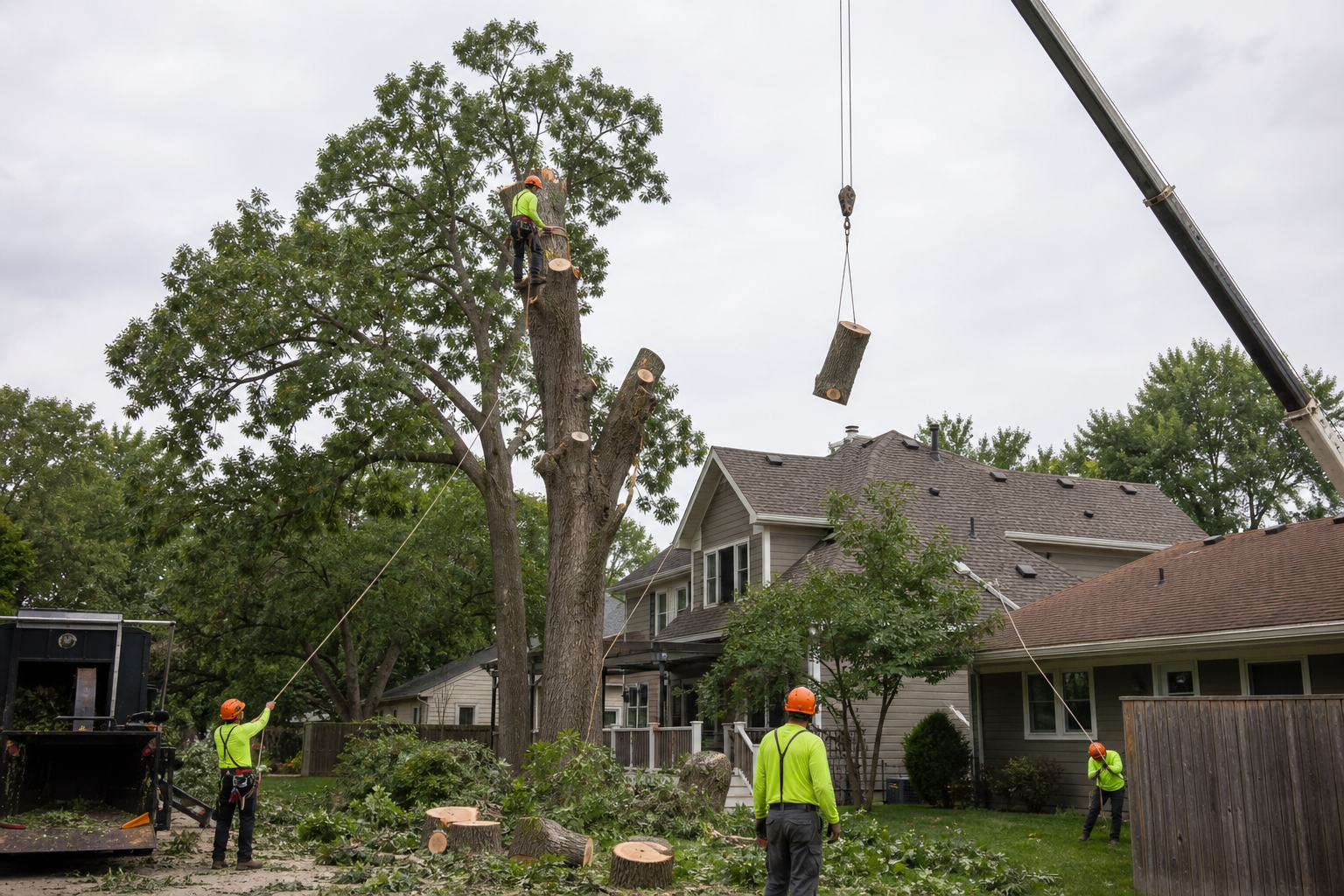
Then there is the machine that changes the equation. Where a tree sits over a roofline, a pool, or anything that cannot absorb a falling limb, a crane lifts whole sections out and sets them down in open space rather than lowering them through the obstacle. The machine and its operator are often the largest swing on the estimate. But a crane sometimes lowers the total rather than raising it, because it can finish in a morning what would otherwise take a rigging crew two days.
Access decides which of those methods is even on the table, and it belongs on the estimate as its own line item. How close a vehicle can get, how wide the way in is, how far material must be carried by hand, and how much clear ground sits under the tree for pieces to land — all of that gets assessed before a crew picks a method, because it rules out methods before price enters the conversation.
What is left once the tree is down is a second job hiding inside the first. Brush gets fed through a chipper or hauled away, and trunk wood is heavy and typically priced by the truckload it fills. One detail the field rarely mentions: the disposal half of the job is often negotiable in a way the cutting half is not. Leaving rounds on the property, or keeping the chips, changes the number because it removes work rather than discounting it.
"Tree removal" usually stops at ground level, and the stump is its own job. Grinding is a different machine, often a different visit, billed on its own terms — the diameter at the flare rather than the trunk, how deep the grind needs to go, and whether the grindings get hauled off or raked back into the hole. That is often why two estimates look mismatched: one included the stump, the other never mentioned it.
Two estimators can look at the same tree and come back thousands apart. The instinct is to assume one is padding the number. Usually neither is — they priced two different jobs. One assumed a bucket truck could get in close; the other planned to climb. One read the dead limbs as ordinary; the other read them as a rigging problem. One included the stump and the haul-away; the other quoted the cutting alone. The gap is almost always a disagreement about method and scope, not honesty.
The drivers travel even when the prices don't. Cost research published on the other side of the world — a South African rundown of what actually moves the number on a tree job — sits on the same physical facts already laid out: size, weight, reach, and where the wood ends up. The currency is unrecognizable. The variables are not. That is the part that travels: the drivers, not the price tag.
An estimate can be compared only once it states its assumptions — the method it counts on, whether the stump is included or left for another visit, where the wood and brush end up, and whether hauling is already priced in. Two estimates that answer all four line up well against each other. One that leaves any of them unanswered can look close in total while describing an entirely different job.
The number on an estimate was never arbitrary, even when it arrives looking like one. It is the tree, the ground around it, and the work of getting all of it off the property, written down as a single figure. A homeowner who can see the parts that built that figure is doing something different from one who simply receives it — reading the estimate, rather than just accepting it.